Basel III-Aligned ORM Intelligence Platform
Master operational risk with RCSA, KRI monitoring, incident management, FAIR quantification, Monte Carlo simulation, bow-tie analysis, and operational resilience — all built on Basel III's 7-element ORM framework.
From risk identification through quantification to resilience testing — manage the complete operational risk lifecycle with AI-powered intelligence and full governance.
Identify. Quantify. Mitigate — operational risk mastered.
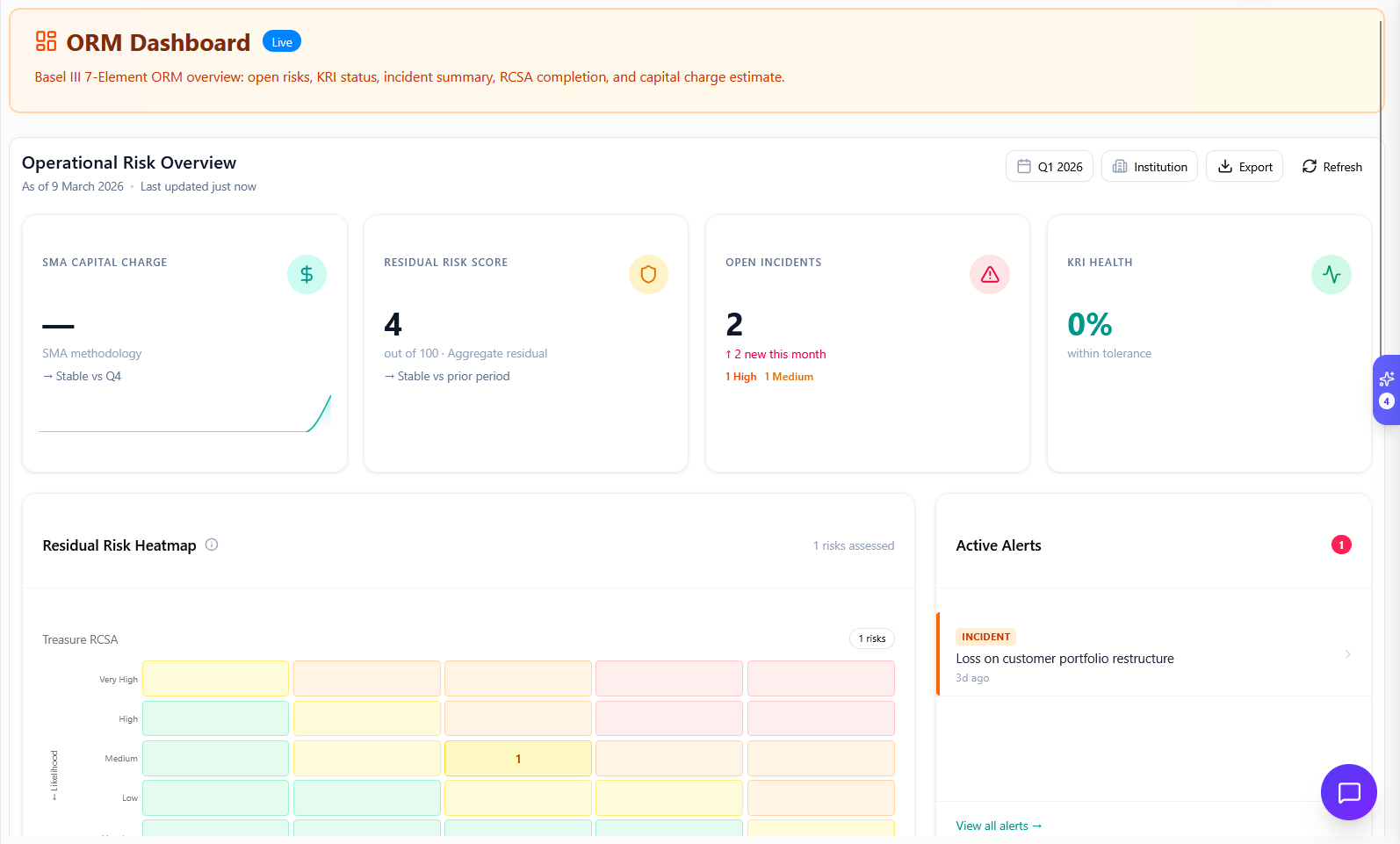

ORM Dashboard
12 integrated modules covering the full operational risk lifecycle — from RCSA through quantification to resilience, all Basel III aligned.

The executive command center consolidating Basel III's 7-element operational risk framework — capital charge (SMA), incident summary, top risks, KRI health, RCSA status, and risk appetite alignment in one view. Interactive heatmaps, trend overlays, and drill-down capabilities provide real-time operational risk intelligence.
Key Features
Basel III SMA capital charge monitoring with real-time operational risk capital adequacy tracking
Interactive risk heatmap with heat-based severity mapping, trend overlays, and drill-down to individual risks
Top risks, KRI health indicators, incident trends, RCSA completion rates, and risk appetite alignment at a glance

Risk and Control Self-Assessment management engine supporting multi-dimensional risk evaluation across business lines. Features inherent risk scoring, control effectiveness assessment (Design & Operating), residual risk calculation, and structured remediation workflows with full governance and approval chains.
Key Features
Assessment management with business unit, risk category, assessment period, and multi-level approval workflows
Risk ratings with likelihood × impact scoring (1-5), inherent vs. residual risk visualization, and control gap analysis
Workflow governance with draft → review → approve lifecycle, delegation rules, escalation triggers, and full audit trail

Key Risk Indicator tracking and alerting engine with traffic-light dashboard visualization. Monitors operational risk indicators against defined thresholds (Green/Amber/Red), tracks trends, identifies breaches, and provides AI-powered insights for proactive risk management and early warning detection.
Key Features
Traffic-light dashboard with Green/Amber/Red threshold monitoring, breach history, and trend analysis
Individual KRI tracking with current values, target thresholds, tolerance bands, and historical trend graphs
AI-powered pattern detection identifying emerging risks, correlation between KRIs, and predictive breach alerts

The hierarchical risk classification engine organized by categories, subcategories, and event types aligned with Basel III loss event taxonomy. Maintains a centralized risk library with standardized definitions, mapping to business lines, and governance controls ensuring consistency across the organization.
Key Features
Multi-level risk categorization with Basel III-aligned categories, subcategories, and event types
Risk library with standardized definitions, business line mapping, and regulatory classification tags
Taxonomy governance with version control, change management workflows, and cross-organizational consistency checks

Loss event recording and reporting engine capturing operational risk incidents with severity classification, financial impact quantification, root cause analysis, and Basel III loss event reporting. Supports near-miss tracking, recovery monitoring, and incident lifecycle management from registration through resolution.
Key Features
Loss event register with incident type, business line, severity, financial impact (gross/net/recovery), and root cause
Basel III loss event taxonomy classification with near-miss tracking and boundary event handling
Incident lifecycle workflow from registration → investigation → root cause → remediation → closure with audit trail

Risk appetite framework management with threshold monitoring and governance escalation. Defines risk appetite statements, tolerance limits, and capacity boundaries across operational risk categories. Monitors actual risk levels against defined appetite with automated breach detection and board reporting.
Key Features
Risk appetite framework with appetite statements, tolerance limits, and capacity boundaries per risk category
Real-time threshold monitoring with automated breach detection, escalation triggers, and exception management
Governance reporting with board-level dashboards, appetite utilization trends, and compliance attestation workflows

Monte Carlo simulation and stress testing engine for forward-looking operational risk assessment. Supports scenario design with frequency/severity distributions, correlation modeling, multi-scenario comparison, and capital impact analysis. Generates probability-weighted loss estimates for regulatory capital calculations.
Key Features
Monte Carlo simulation with configurable frequency and severity distributions (Log-Normal, Poisson, Pareto)
Stress testing with historical, hypothetical, and reverse scenario types and correlation modeling
Multi-scenario comparison with capital impact analysis, VaR calculations, and regulatory capital adequacy assessment

Factor Analysis of Information Risk (FAIR) methodology engine for structured cyber and operational risk quantification. Calculates Loss Event Frequency (LEF) and Loss Magnitude (LM) to derive Annualized Loss Expectancy (ALE) and Value at Risk (VaR) with Monte Carlo simulation for probabilistic loss estimation.
Key Features
FAIR methodology with Threat Event Frequency, Vulnerability, Loss Event Frequency, and Loss Magnitude calculations
Cyber risk quantification with asset valuation, threat capability assessment, and control strength evaluation
Annualized Loss Expectancy (ALE), Value at Risk (VaR), and Monte Carlo-based probabilistic loss distributions

Visual risk modeling engine mapping causes (threats) on the left, the central risk event, and consequences (impacts) on the right — with preventive controls on the left barrier and detective/corrective controls on the right. Interactive visualization supports control gap analysis and multi-layer governance review.
Key Features
Left-side threat mapping with root causes, escalation factors, and preventive control barriers
Right-side consequence mapping with impact categories, severity levels, and detective/corrective controls
Interactive visualization with control effectiveness indicators, gap analysis, and remediation action tracking

AI-powered relationship mapping engine visualizing connections between risks, controls, incidents, KRIs, and business processes as an interactive network graph. Identifies hidden dependencies, causal chains, and concentration risks that traditional tabular views miss.
Key Features
Interactive network graph mapping risk-control-incident-KRI-process relationships with drill-down navigation
AI-powered pattern detection identifying hidden dependencies, causal chains, and risk concentration hotspots
Cluster analysis revealing correlated risk groups and cascade failure paths across business lines and processes

Critical services identification and resilience testing engine aligned with Basel III operational resilience requirements. Maps important business services (IBS), defines impact tolerances, models disruption scenarios, and tracks recovery capabilities. Integrates incident data for continuous resilience validation.
Key Features
Critical service mapping with Important Business Services (IBS) identification and dependency chain visualization
Impact tolerance definition, disruption scenario modeling, and recovery capability assessment with breach analysis
Incident integration linking actual disruptions to resilience scenarios for continuous validation and improvement

The governance framework and reporting engine consolidating policy management, committee structures, audit trails, and regulatory report generation. Pre-built report templates cover incident summaries, KRI dashboards, RCSA outcomes, scenario results, and resilience assessments with Basel III alignment.
Key Features
Governance framework with policy registers, committee structures, delegation matrices, and accountability mapping
Pre-built regulatory reports — incident summaries, KRI dashboards, RCSA outcomes, scenario results, resilience reports
Full audit trail with every risk assessment, approval, incident, and report action logged for regulatory examination
The platform that turns operational risk from reactive firefighting into proactive intelligence
Built around Basel III's 7-element ORM framework with SMA capital charge monitoring and loss event taxonomy.
Traffic-light KRI monitoring with threshold breach detection, trend analysis, and AI-powered predictive alerts.
Structured cyber and operational risk quantification with LEF/LM methodology and Monte Carlo simulation.
Forward-looking scenario analysis with configurable distributions, stress testing, and VaR calculations.
AI-powered network visualization revealing hidden risk dependencies, causal chains, and concentration hotspots.
Every assessment, incident, approval, and report action logged for complete regulatory examination readiness.
Built on globally recognized operational risk management standards and frameworks
Basel III SMA
Basel III ORM
ISO 31000
COSO ERM
FAIR Framework
Local Regulators
Operational risk management tailored for regulated industries — from banking and insurance to healthcare and government.
Operational Risk for Banking
Basel III SMA capital charge monitoring, RCSA workflows for front/middle/back office banking operations, KRI threshold tracking, and loss event management aligned with banking regulatory expectations.
Operational Risk for Fintechs
RCSA tailored for engineering and product teams, KRI monitoring for platform uptime and deployment failures, and tech-specific risk quantification for fast-moving fintech operations.
ORM for Insurance Operations
Underwriting risk assessment, claims processing risk monitoring, agent network risk management, and operational resilience frameworks designed to protect policyholders and meet insurance regulatory standards.
ORM for Trading Operations
Trading desk RCSA workflows, KRI monitoring for trade execution risk, FAIR cyber risk quantification for market infrastructure, and operational resilience for trading platforms and settlement systems.
ORM for Lending Operations
Branch operations RCSA, field agent process risk monitoring, delinquency and fraud KRIs, and Monte Carlo capital estimation tailored for microfinance institutions and NBFCs.
Everything you need to know about Operational Risk Management.
See ORM in action. Schedule a demo and discover Basel III-aligned operational risk management with AI-powered intelligence.